Monday, January 14, 2013


January 14, 2013

Water, Winnowing, and the Tentacles of Donald Trump

A quick matatu ride down A2 from Kakamega got us to Kasavai this morning.  There we were greeted at the CLOUT/Watafutaji office by two widows who were hauling out soy bean plants that had been held (over night?) in the now even more multipurpose office.  Today would be a day for winnowing.


But first, there would be the putting away of new books and play school supplies and instruction on the use and care of biosand water filters to be installed later in the day in the office and in three selected widows’ houses.  About 25 widows crammed themselves into the front room of the office along with the four filters and all the play school and sewing equipment as Eric from Friendly Water for the World instructed the group on the use and maintenance of the filters.  Everybody seemed to comprehend all, but only time will tell.


The instruction was followed by the immediate installation of the first filter in the back room.  The hollow concrete box with imbedded syphon weighed about 100 pounds before measured amounts of rock, gravel, and sand were added sequentially, followed by a metal diffuser plate and about 20 liters of dirty stream water into the top of the concrete tank.  After the first 20 liters or so of water had been added and the tank was full to the top of the syphon, a splash of brown water popped from the spout to be followed by a continuous and ever-more-clear stream as additional water was poured in to the tank. 


The stream halted automatically when the amount of water dispensed equaled the amount of water added and the level in the tank lowered to the top of the syphon tube.  Only one more step to go.  Since we were not in a hurry to get potable water today, Eric had time to do a sanitizing step.  He poured some bleach solution backwards into the syphon in order to assure that the downstream portion of the filter system was germ-free from the start.  Once he had done this, all there was left to do was to pour copious amounts of water through the filter unit and then let it sit until tomorrow or the next day, at which time it will be fully functional.  Over the first 30 days or so, the unit will reach its full potential as the local bacteria establish themselves in the “bio-layer” and then can eliminate the maximum amount of harmful water-borne organisms.

Eric, David Ashimosi (a 2011 Mukumu Boys HS grad), and I then delivered the remaining three filter units to selected widows’ houses scattered around the village.  We could do this only with the help of three strong guys who we hired for the task along with their cart.  Moving the units (two at one time and one later) across hill and dale was an unbelievably strenuous task.   My guess is that the first house was about one mile from the office, the second was three miles from that, and the third was two miles from the office in the opposite direction.  Eric installed the first two of these household units (adding rock, gravel, sand, water, etc.) and he expects to do the same with the last tomorrow or Wednesday.


When we returned to the office to pick up the last of the units for delivery, we found Sandy busily engaged in the winnowing of soy beans with the widows.  These beans had recently been harvested by the widows from their collective plot and were ready to be freed from their pods, stems, and stalks.  Sandy was beaming with excitement and joy.
 
After the harvested plants had been dried (and been stored in the office) the widows spread them out this morning on tarps under the full heat of the equatorial sun.  By afternoon they had dried sufficiently more and were ready to go.  First, the beans had to be freed from the dried plants.  This involved stomping on them and beating them relentlessly with large sticks.  Sandy loved this part and she thought she had winnowed for the first time in her life. 

 
Not so, she discovered as time went on.  This was just preparation for winnowing.  Next, the largest stems and stalks were picked up and removed from the beaten pile.  Then the winnowing act itself was carried out by only one of the widows.  She held a bucket of beans and broken stems and stalks above her shoulders and poured it carefully into another large basket on the tarp, letting the wind separate the majority of broken stems, stalks, and pods from the beans.  She did this repeatedly until the beans were clear of refuse.  And to assure that not one bean was lost, a few widows swept the tarps clean and others bent over at their wastes in the grass and picked up beans that had strayed from the tarp.   All was completed in one afternoon.


While the ladies winnowed, I delivered filter units and discovered that 2 of 3 Kenyan men believe (now, believed) that our President, Barack Hussein Obama, is a Muslim.   Why?  “He must be, his middle name is Hussein”.  Needless to say, the sample size is small but Sandy and I performed an educational intervention on the two, nonetheless.  Has Donald Trump been here?
 
Boil this water no more.

Sunday, January 13, 2013


Sunday, January 13, 2013

Weaver Birds, Their Nests, Big Trees, a Shave and a Haircut - Two Bits, a Boda Boda, and a Pickey-Pickey

Each morning we awaken to the sound of a flock of weaver birds in two large trees just outside our room.  This morning was no exception, with more activity than usual.  We looked up and saw at least 25 birds chirping, fluttering around, and actively building nests high up in the trees.  When we looked down, we saw six nests on the ground.  Were they there yesterday after Friday night’s storm?  We don’t know.


Speaking of big trees, as we were leaving the hotel to walk to the center of town we inquired about the large trees that had been felled recently on the front lawn of the hotel.  Rumor had it that the hotel had cut down three big trees to make room for a helicopter landing pad.  The largest tree, an ancient eucalyptus, had to be 1.25 meters in diameter.  Its remaining stump is being hacked out by hand.  The Golf staff tells us that the area is being cleared of trees so a wedding reception venue can be constructed.  Too bad in either case, the trees were beautiful and certainly more friendly to the environment and the eye than another wedding building or tent.

Leaving the vestiges of the trees behind us, we took the short walk to Tusky’s and then to Nakumatt  to scope out pre-school supplies and things we might need to purchase next week.  Nakumatt “Mega” was surprisingly short of just about anything Sandy thought necessary.  But they did have a lawn mower that could be used to cut our lawn in just three days. That’s my foot next to it. It looks like Tusky’s has become our new second favorite store, behind Yako.

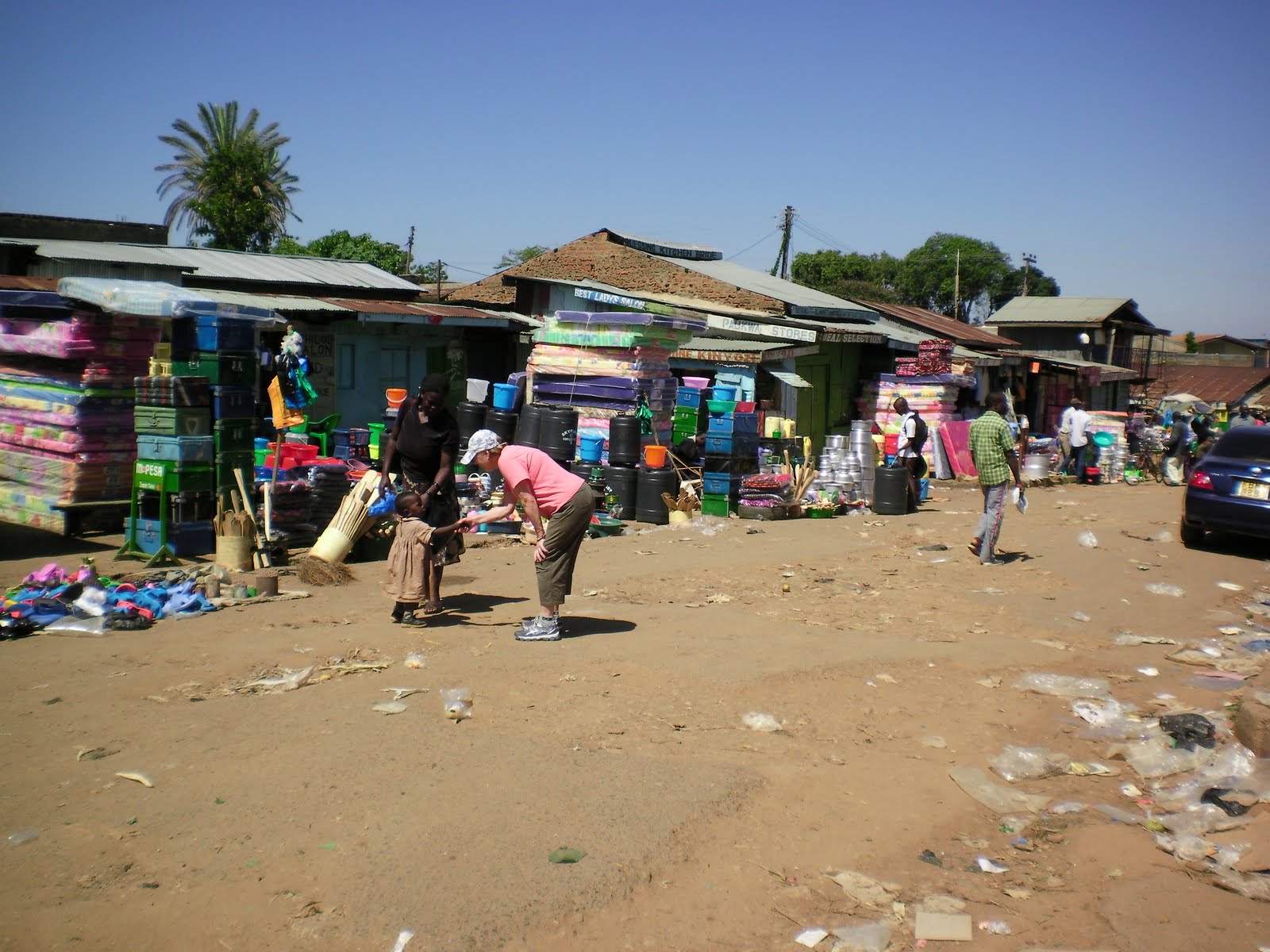
With visions of Nakumatt dancing in our heads we headed through the local open air market in search of sights and then “Main Street”.  The market had the usual assortment of goods on display, most all dusty from the dirt roads and constant traffic.  We bought nothing.


On Main Street stand establishments, all very small, that provide just about any product or service you might desire.  One of these is my Kinyozi.  That’s a barber shop if you did not know.  There a msungu (foreign white man) can get a haircut for anywhere from the African’s price (about 40 shillings or “bob”) to whatever he will pay.  I’d been quoted prices as high as 1000 bob in the past and settled on 200 to 400, but now I’m a recognized returning customer and was quoted a price of only 80 bob – that’s less than a buck.  I don’t have much hair, but the experience feels great, especially since it’s followed up with a head wash and massage.


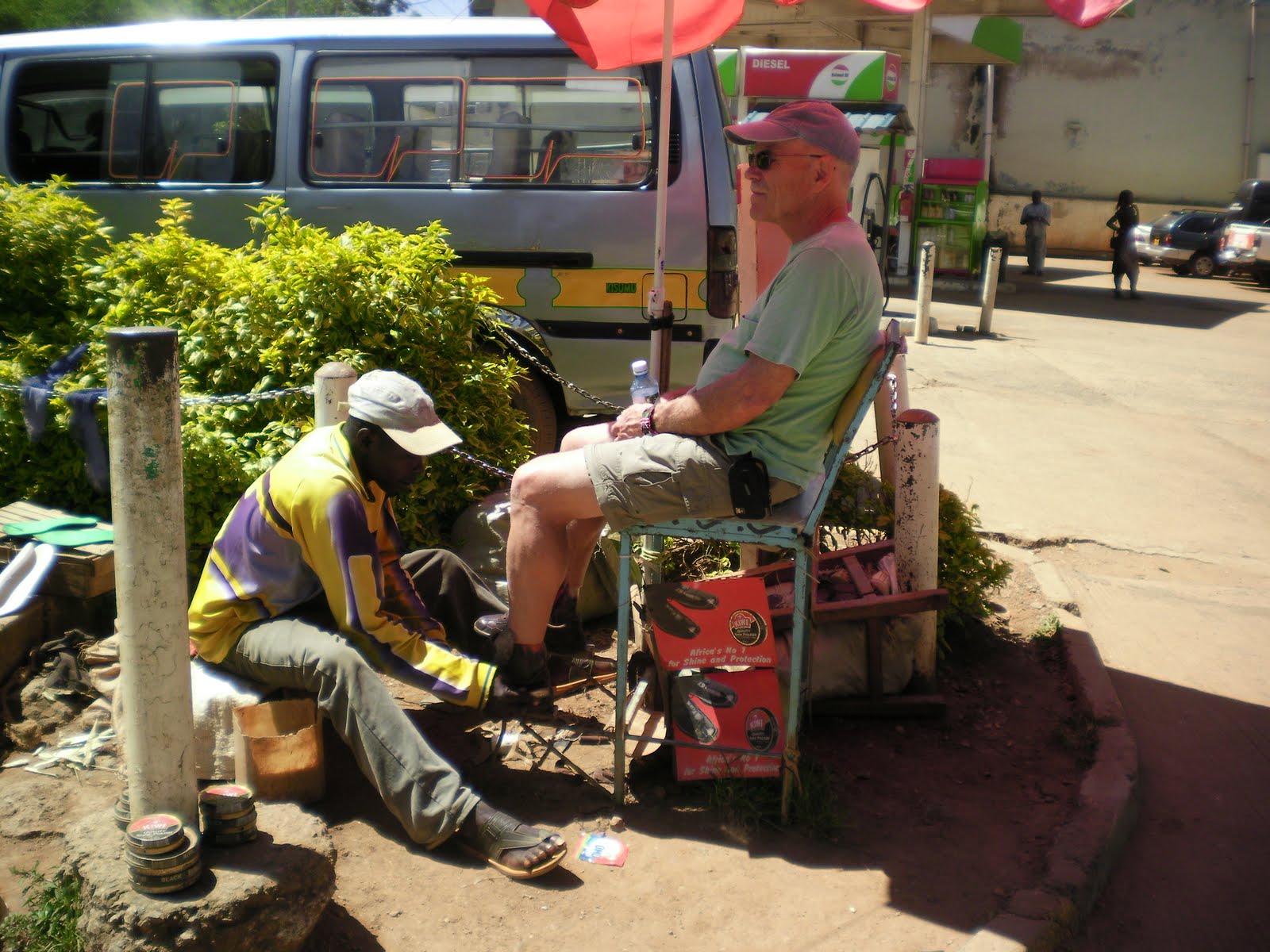
On the way back to the hotel, we had to stop at my shoe shine guy for a quick clean and polish, including removing the shoe strings and washing them – 20 bob (25 cents), with Christian advice on herbal medicine right next door.


At about 1 PM we decided to try a new place for lunch, the Savona Isle Resort.  It’s about two miles up the road, a 10 minute ride on the back of a boda boda (bicycle) or five minutes on a pickey-pickey (peekee –peekee).  We opted for the boda boda on the way there for safety’s sake.  The resort was built a few years ago but never really made it big.  It’s a on an island, we think, since you have to cross a river to get to it.  Four or five big thatched roof bandas and a swimming pool area seem to comprise the entire thing.  Dust and cobwebs are thick on the beams inside the bar and restaurant area.  The staff is pleasant and helpful.  The pool and surrounding play area attract lots of kids, all of whom have to pay to get in.  We had chicken and chips in the bar along with a cold beer – all very tasty.  With lunch and beer in our bellies, we ran the gauntlet of kids asking for money near the bridge (and a hooker on the bridge) and flagged down a single pickey-pickey to get us home.  The pickey-pickey was in fact far more comfortable than the boda boda and we felt more secure too, especially since the driver went slowly (Sandy having said poli,poli - slowly, slowly - a couple of times in his ear as we started).


Saturday, January 12, 2013


Saturday, January 12, 2013

 
Bullfights in Kyhega and Celebration in Kasavai


As usual, we hired a truck and driver to help us get the goodies we brought from America and purchased in Kakamega to Kasavai.  I had written down Ben’s number from last year and he was happily available again this year.  He arrived at the Golf at 8 AM, at which time he, we, and a hotel security guard loaded the truck to the gunwales, if that’s possible.  Then  down A2 we trundled quickly and merrily until we came upon a bus blocked by about one hundred people (all men and boys, we believe) walking down the road with a man in the lead waving a black, gold, and green  flag and another blowing the now infamous vu-vu-zela.   They were in no mood to let traffic through in either direction.  Could this already be the start of another political rally?  No, it’s Saturday morning and this is Kyhega - that means bull fights.

We’ve never actually seen a bullfight, although I did try to a few years ago but got there too late.  Here, in Kyhega and other small towns and villages, local bull owners and fans gather early Saturday morning in an outdoor enclosure on the outskirts of town.  There, as I understand it, the owners pit their bulls against each other, taunting them and encouraging them to fight each other, kind of like a cock fight.  I don’t know how they determine who has won, but I do know that the bulls do not fight to the death, for all that’s worth.  When the fights are over, the bulls and their respective fans march home down the highways and roads celebrating the fight and perhaps the winner.  We were behind one bull and his throng of fans, with the men and boys in the lead and the lone bull bringing up the rear. 


When we arrived at the Quaker church in Kasavai, where today’s festivities were to be held, two or three widows were already making preparations.   Pots were being filled with water, and cooking fires were being built, all inside a small cook house behind the church.  The truck was unloaded quickly with the help of two village men who happened to be at the right place at the right time.  A fifty shilling tip was a good start for the day for each of them.  Meanwhile the cook house was filling with smoke.


Sandy and I unpacked goodies for the next hour or so and lined them up on tables and chairs as widows and children filled the room.  By the time the meeting and festivities began around 11 AM, we had a full contingent of 45 widows, 2 family members representing the 2 widows who died in 2012, in excess of 100 children, an assistant chief and his wife, the village sub-chief, a village elder, the pastor of the church, a church deacon, and honored guests and speakers, including Chris and Connie Shisanya, Sandy and me, a student from Kenyatta University, a 16 year old orphan girl who the Shisanya’s have taken on as a live-in housekeeper and “eldest daughter”, and  a lone homeless man who ended up staying in the back of tehchurch for nearly the entire day.


As usual, the festivities began with the widows singing and dancing while praising the Lord and extolling the virtues of their guests from America, us.  This was followed by prayers and then short and not-short introductory speeches by each of the above mentioned dignitaries, including us.  In addition, as seems to be traditional, a few young children recited poems or sang, and David Ashmosi a 2011 high school graduate who had been supported by CLOUT Cares told current students and recent graduates to study hard and seek out opportunities.  Finally, tea, eggs, groundnuts, and bread and butter at around 12:30 provided a much needed break for the children and for us.


Sandy and I followed the break with short, and I mean short, presentations about issues dear to our hearts.  Sandy talked about the value of play and how children learn from it.  For example, she showed how playing with Duplo blocks helps young children to learn colors, numbers, addition and subtraction, eye-hand coordination, and cooperation with others.  From simple picture books with text, they can learn the alphabet, reading, science, and life skills.  Play is their “work”.  I followed and talked about the importance of drinking clean water at all times.  I introduced the concept of the use of the BioSand water filters that we are having installed on Monday in their CLOUT multi-purpose “office” and in a few of their homes.

A belated celebration of Christmas followed.  Each of the widows was given a small amount (by US standards) of cash to help manage increased expenses associated with the start of the new year.  This year we also established a fund to help defray funeral and related costs for the families of widows who died during the year, leaving their children as total orphans.  These small sums of cash brought joy and smiles to the widows’ faces and tears to their eyes.


Then we distributed the goodies we brought from America and the foodstuffs and household items we purchased at wholesalers in Kakamega yesterday.  Each widow accumulated a hefty stash of stuff, including the things I mentioned yesterday and four reusable “shopping” bags each, donated by our friends in America.


A 3 PM “lunch” had been prepared by the ladies and we consumed it rapidly. Everybody, including widows and guests partook of a hearty meal of five chickens that had started out the day clucking in the cook house, goat, ugali, sukuma wiki, pumpkin, and fried bananas.    All went home happy and full, carrying their goodies and memories with them.


And, I got to see my namesake, Terry (the little one), again who is about one and a half years old now.


Once back in Kakamega and snuggled behind our Tuskers, we spotted a huge bird in flight right in our back yard, which some of you bird watchers may be able to identify if you watch carefully.