Friday, January 11, 2013


Friday, January 11, 2013

Yesterday Travel and Bumpy Roads, Today Shopping and Presidential Campaign Rallies

Yesterday was a day a bit more bumpy than we had expected.  Our EZ-Coach trip from Nairobi to Kakamega was not on roads recently rebuilt by the Chinese, to say the least.  But, the trip started at 9:25 AM, only 25 minutes late, and ended at 6:25 PM, exactly 9 hours in length, as we had expected.  The first three hours took us to Nakuru where we got a potty break and an ice cream plus a 250g bag of tea for each widow.  The next six hours came with none of the above.   They came with slow and bone jarring progress on the road to Kapsabet, often with potholes so large and numerous that the bus had to abandon the road altogether.  But we made it, with bladders full, good humor still intact, and daylight nearly gone.


We found a big taxi and arranged our quick 300 shilling ride to the Golf Hotel with our six huge checked bags, two very heavy carry-ons, and 12.5 kg of tea.  Turns out we arrived a day earlier than expected but the Golf was ready for us.   The staff put all but our carry-ons into a storage room and we were assigned to room 204 with a balcony overlooking the grounds and a sliding glass door that opens to the balcony and the barking guard dogs on the adjacent golf course (not affiliated).  And, we have a brand new, fancy mosquito net!

Breakfast today at 8:30 was followed immediately by a meeting with the fellow who will deliver and install four BioSand water filtration units in the village on Monday.  He was impressive, especially in his apparent dedication to making these things get used properly.  Each comes with immediate training in how to use them for all who might use them, especially the children of the households.  He and his staff do follow-up evaluations every two weeks for a couple of months followed by less frequent visits to make sure all is well.

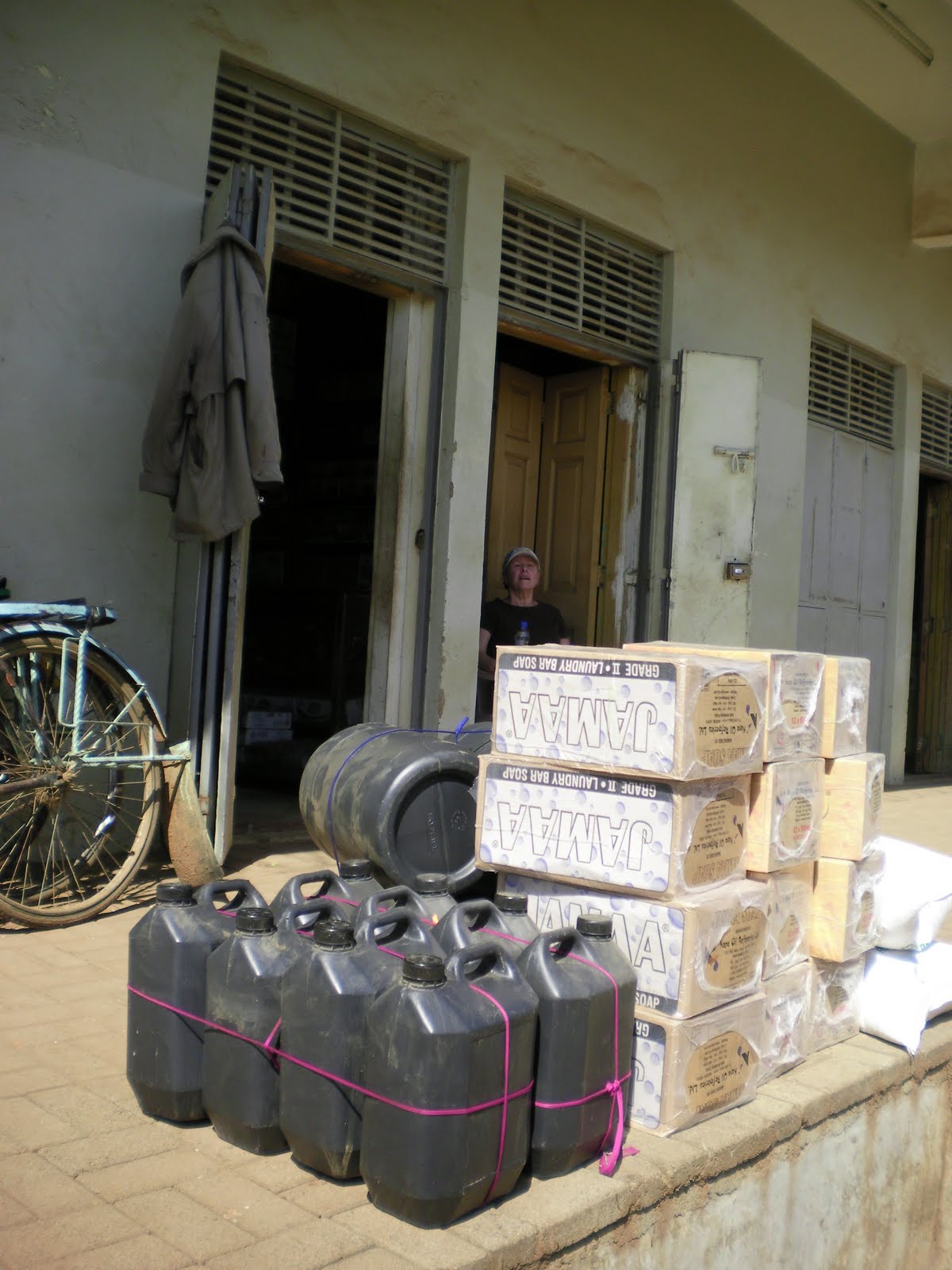
The majority of the day was spent shopping at local wholesalers for items to be distributed along with the tea to the widows tomorrow:  100 kg rice, 50 tins cooking oil, matches, Vaseline, 100 kg sugar, biscuits, and 50 kg lentils.  These items will fit nicely into the 250 or so donated reusable shopping bags. Many of the books and toys we brought with us will go into two metal footlocker we purchased today.  And we purchased new plastic jerry cans into which clean water will be delivered by the BioSand filtration units.


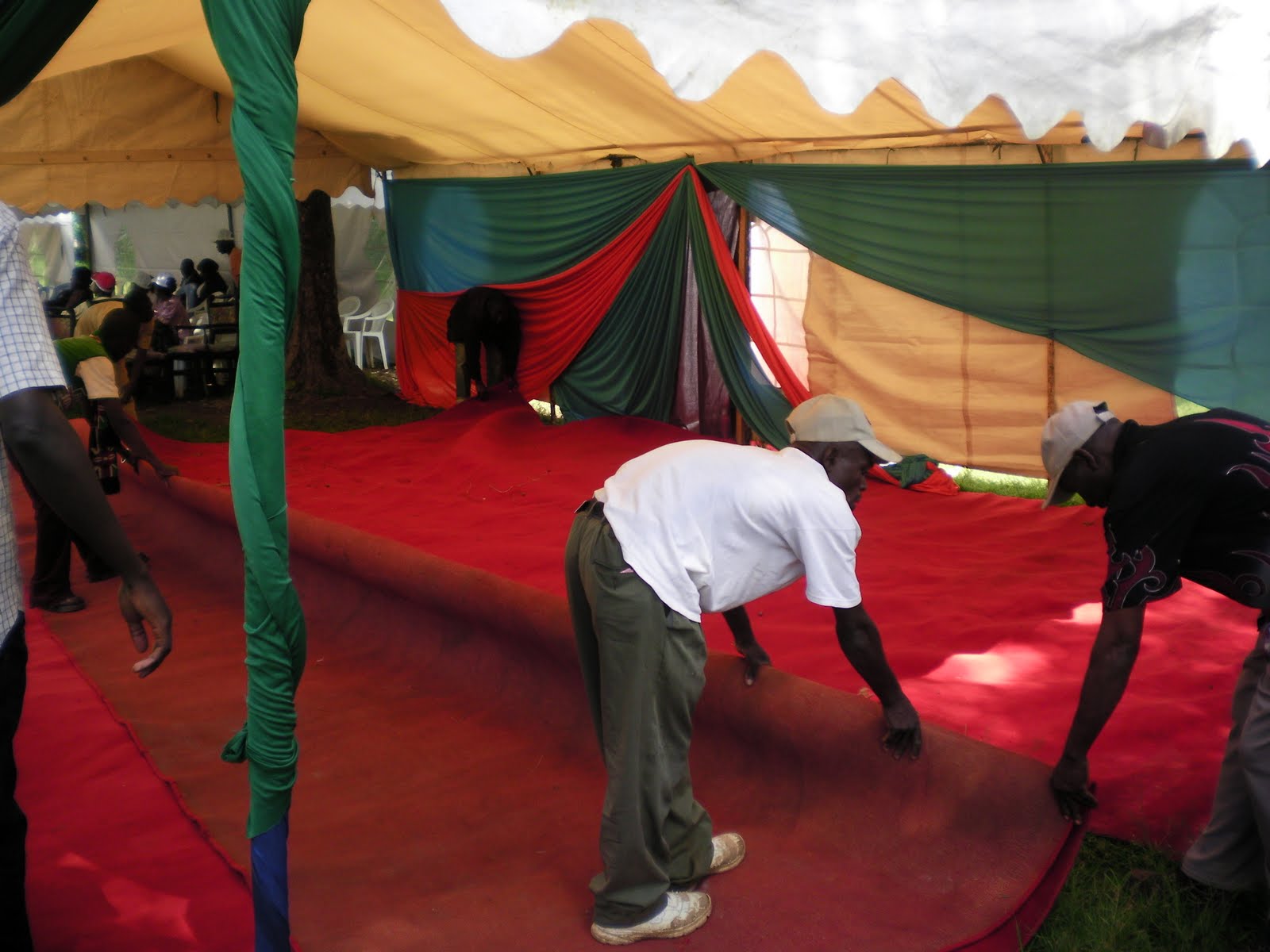
All this took place while the CORD coalition held a big rally at Miluru Gardens (park) just a couple of blocks from the hotel and while CORD candidates for President, Vice President, senate, etc., came into town on helicopter s and filled our hotel with themselves, security personnel, and coalition muckity-mucks dressed in orange, mostly.  In fact, after we finished our meeting with the water filtration fellow, Eric, at around 11 AM we found that we were locked into the dining room for security reasons.  The current VP and PM were attending meetings and having lunch just over our heads.

 
Sandy told a security guard that she was a friend of Raila Odinga (ODP Presidential Nominee and current PM) because we saw him here at the hotel last year.  He must be following her. So, they let us out of the dining room and we headed on our way.  Miluru Gardens park was filling fast, with construction of a stage and testing of the very loud speakers going on.  Music filled the air.  Lots of watchers and supporters from the three parties in the CORD coalition milled everywhere.  .The truly ardent fans had already found seats under the many, many tents erected for the occasion.  As we walked through the park, I masqueraded as an ODM supporter by wearing a free ODM cap given to me at the hotel.  It was surprising how many people gave me a thumbs us and said O-D-M to me throughout the day, as long as I had my orange cap on.


By 2:00 PM or so, things were in full swing at the park and we had completed our first round of shopping, having all delivered by one of the wholesalers to our hotel by 4:30.  Candidates had finished meetings with their wealthy supporters and were on the stump with at least 10,000 people listening while sitting, standing, or hanging from the trees.   Some even stood on their bicycles (kickstands down).   


Tomorrow – yet another coalition comes to town for an event just as big. We’ll be in Kasavai.

Wednesday, January 9, 2013


Wednesday, January 9, 2013 (Second Post)

Kenyatta University

This afternoon, Chris Shisanya, Dean of Humanities and Social Sciences, gave us a tour of Kenyatta University.  The university has about 45,000 students, 25,000 of whom matriculate at the main campus where Chris deans and teaches.  Quite an impressive campus it is too, at about two square miles.  The university made the transition from a college which was part of the University of Nairobi to a full independent university in 1985.  It is truly an international university, collaborating with some 85 other universities around the globe.  Chris got both his BS and MS degrees here at KU and received his Ph.D. in Germany.
 
The new “Post Modern” library is probably the most impressive building we saw, having been built quite recently.  There is an even bigger and more impressive building being constructed.  It will house the Deans of the various schools and ?? – it’s a monster.  Students are just arriving on campus for second semester classes, so we did not get to see any classes in session as Sandy had hoped.  We did stop at the art school and walked around the working sculpture studio, and we did get the KU T-shirt.


But they don’t have a carousel as nice as the one at the Sportsview.
 
Tonight we go to Chris and Connie’s house for more CLOUT Cares discussions and dinner.

Wednesday, January 9, 2013

Elephants, Kasarani, and BioSand Water Filters

Elephants:  more about the plight of elephants at Sheldrick Wildlife Trust refuge and in the wild.

Right now there are 25 baby orphan elephants, ages 6 months or so to 3+ years, at the refuge.  The pens are nearly full and many more baby elephants are expected to arrive in the coming months due primarily to poaching and drought.  The dry season has started in Kenya and little if any rain is expected through March.  Although true drought is regional, the dry season is accompanied by lack of food for elephants throughout the country.  The largest national parks, Tsavo and Tsavo East, are already experiencing drought and withered vegetation.  

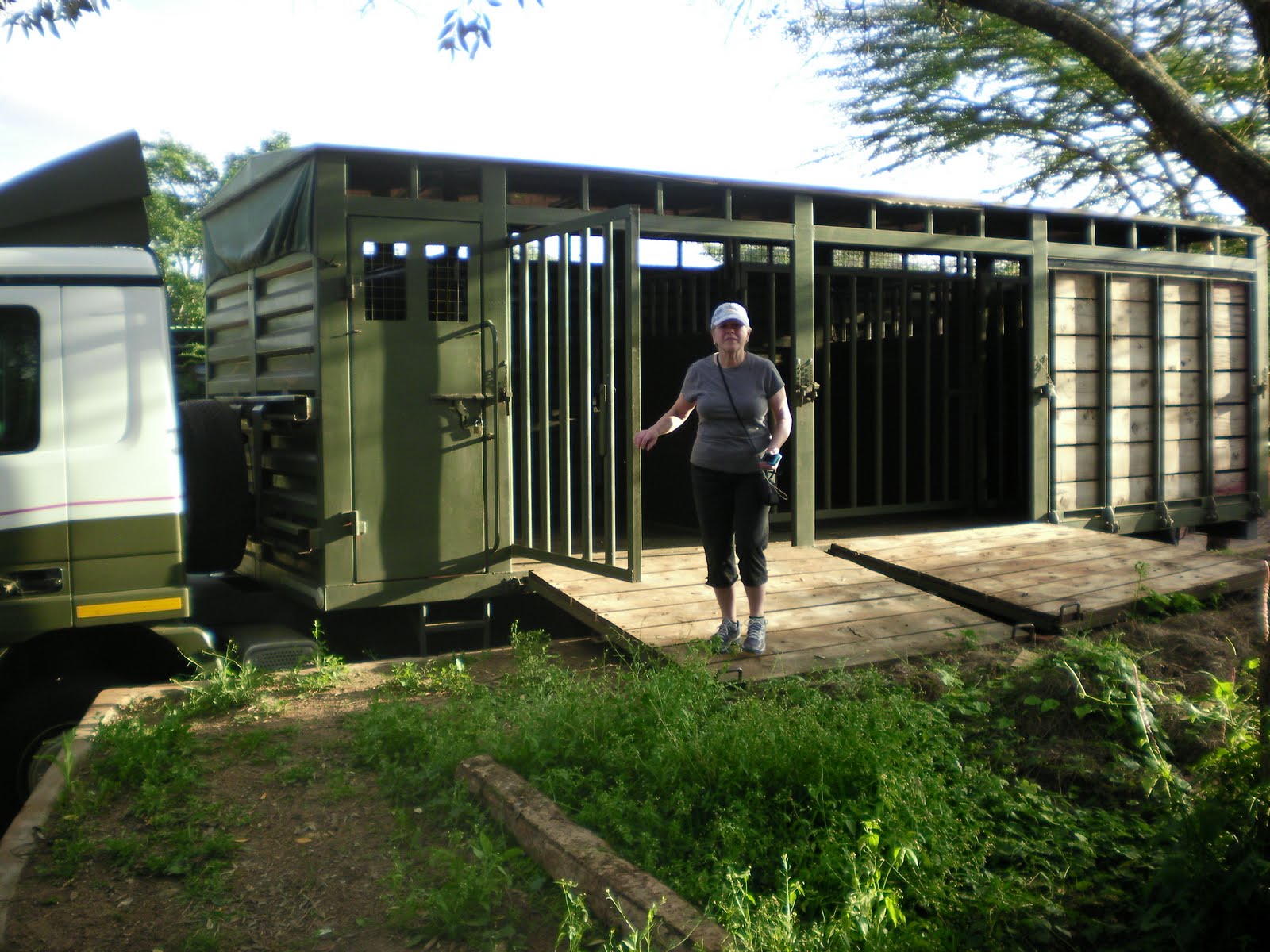
The dry weather in the Tsavos affects the elephants there and it affects the orphans in Trust refuge hundreds of miles away in the outskirts Nairobi.  Normally, the three year old elephants in the refuge would already have been transferred for care and reacclimation to the semi-wild at Ithumba in Tsavo East.  But they have been held back due to lack of natural food at Ithumba.  After three orphans are transferred this week or nextby truck, their food will have to be supplied by the keepers at Ithumba, at least until the rains return in the spring.  Others will be transferred from Nairobi  only when they can be assured of plentiful natural vegetation or when no space whatsoever is available in Nairobi.  This is the truck.
 

The dry weather affects the native wild elephants as well.  When there is little or no food, they expand their foraging ranges, often to land and villages which surround the national parks and wildlife sanctuaries.  The local human residents resent this and often take their resentment out on the elephants intruding their shambas and farms.  Older elephants are snared, poisoned, speared and killed, and any young ones that escape are left on their own.  For those still nursing from their mothers, this means certain death unless they are rescued by humans.  Those young elephants not nursing become easier prey for hyenas and cats.

All of this is on top of the even larger problem of poaching adult elephants for ivory.  The price of ivory has increased nearly 100-fold in the last few years due to market demand in China and eastern Asia.  It’s hard to stop the poaching when a poacher can make more money from just one elephant than he could earn in a year of labor or farming.  

Kasarani:

Each time we visit Kenya, this is our seventh visit in eight years,  we begin our trip with a short stay at the Sportsview Hotel in Kasarani, a northern suburb of Nairobi.  There we meet with our friends and Kenyan CLOUT counterparts, Connie Ambasa Shisanya and Chris Shsanaya, to discuss the past and plan for the future.  When we first came to Kenya some eight years ago, the short trip from the Nairobi airport to Kasarani on rutted roads could take nearly two hours.   Now, thanks to Chinese road builders, the trip is only about 45 minutes long.  Roads all over Kenya have shown dramatic improvement in these years.  Our annual bus ride from Nairobi to Kasavai in western Kenya used to be a bone-jarring 12-hour ordeal.  Now, we expect only a 9-hour ride with only an occasional jolt to the back.

Our brief stay in Kasarani gives us a chance to deal with jet lag and to get reacquainted with the Kenyan culture, as well as make short trips to local attractions like the National Museum, downtown Nairobi, the Rothchild’s giraffe sanctuary, Karen Blixen’s homestead (Out of Africa), and the memorial site of the 1998 US embassy bombing.  We also enjoy short walks into the heart of Kasarani.  The streets of Kasarani are generally dirt but can also be mud.  The road to the Sportsview from the main Kasarani/Mwili road is ¼ mile of potholes.  The Sportsview is an oasis just up the road from buildings that are mostly under constant construction and sewage that runs in in ditches next to the streets.  Sounds like heaven, doesn’t it.  We actually like it.  It’s real with no pretence.


BioSand Filters:

Last night’s meeting with Connie and Chris at the Sportsview was accompanied by a meal of local (translate as tough) chicken, goat (mbuzi) meat, spinach, and rice, all washed down with generous portions of beer and/or wine.  Fine dining at its best.


Among things we discussed were ideas for what to do next to help the HIV/AIDS widows of Kasavai escape poverty and disease on their way to self-sufficiency.   Typhoid, dysentery, diarrhea, and other water-borne diseases are major health issues for the widows and their families.  We are going to try a pilot water purification project of using a “Biosand” filtration system.  For the pilot, we’ll have four biosand filters installed around the village, one in the CLOUT/Watafutaji office/sewing center/preschool and three in selected widows’ houses for use by them and their neighbors.  Each filter comes with training on its use and maintenance.  We are told that the filters can last for 30 years with virtually no maintenance if they are used properly.  Each is a concrete box about one foot square and four feet high containing gravel, sand, a metal diffuser plate, and a syphon system.  They rely on the sand and naturally occurring bacteria on it to clean the water of sediment and the majority of water-borne organisms, like e-coli.  The user pours water collected from a stream or roof in the top and collects the same amount (in a clean container) immediately from the spout on the side near the top (at a rate of about 1 liter per minute).  There are no moving parts and nothing to replace.   Each costs about $50, including installation and training.   Installation and training are planned for next week.  We’ll let you know how it works out.  And if it does, we plan on large scale installation later.

Tuesday, January 8, 2013


Tuesday, January 8, 2013

Experience Kenya but Activate Your Patience Before You Activate Your Cell Phone

As Walter Cronkite may have said, “Today was a day like all days, except you were there”.
Ding, ding, 7:11 – you’ve won.  That’s what we could have believed when messages came in on both our cell phones as we lay half asleep in bed at 7:11 a.m. today.   Who could be leaving us a message at this time?  Did we win the lottery?  Was it our driver, Chris, who was to pick us up at 9 and take us to the David Sheldrick Wildlife (elephant and rhino) Trust on the other side of Nairobi?  Was he going to be late?  Was he going to show up at all?  It must be important if someone sent a message to both of us at the same time.  Check that message now!
 
“Dear customer, for legal reasons, your number will be suspended until you complete the registration.    For more information visit any Safaricom shop.” 
 
We did that yesterday, twice, or was that thrice?   We’ll go to the main Safaricom office downtown on the way back from the Trust.  It won’t take more than a couple of minutes to straighten this out.
 
The Wildlife Trust was fascinating as usual.  Twenty-five baby elephants drank milk, ate special foliage, and played with each other just for our enjoyment.   Kainuk and her very best friend, Trukwell, were among the twenty-five, but within the week, they and Kanjuro will be shipped off in a special truck for release into the semi-wild at Tsavo East.   In fact, they practice eating in the stationary truck with their keepers nearby so they get accustomed to the space and are ready to go when the day arrives.


Now for Safaricom!  We were right, it only took a few minutes.  A fellow behind a desk took our names, numbers, etc. as we had supplied just yesterday in writing and on the phone.  He entered the data into a computer and pronounced us whole.  We would have full use of our phones within 40 minutes; all we had to do was wait.  Almost immediately we got another text message saying, “Dear customer, you have been registered with success.  Thank you for staying connected to The Better Option.”  We were certain of our success, again.  
Smugly, off we went to the Masai Market just a few blocks away.  We bought more than we needed and quit after an hour or so. 


Time to head back to the hotel to get ready for a meeting with our CLOUT counterparts tonight.  But, the 40 minutes had long since passed, so we thought it worthwhile to give the phones a test.  We tried calling each one with the other.  We even tried calling our driver who was sitting right next to us.  Unfortunately, both phones gave the same recorded message -.  “Your phone needs to be activated.  Visit customer service at your nearest Safaricom dealer.” 
 
We had just left there 1.5 hours ago.  But back we went at 2:30 pm.
 
By 5:00 PM we had been shuttled between four individuals, each of whom said they could solve our problem, only to shuttle us off to the next with the problem unsolved.  Most of them asked us to fill out the same registration form we had already completed three times.  What would this accomplish since we had text message confirmation on the phones that showed they were successfully registered?  A couple representatives even told us to come back tomorrow – no way.  Finally, a young woman said she could fix it, went away, fixed it, and came back.  We do not know what she did differently from the others other than to really take our problem as one that needed to be solved, not shunted off.  Praise her and the Lord and damn Safaricom.

Moral: next time you’re in Kenya, activate your patience before you try to activate your cell phone.

Monday, January 7, 2013


Monday, January 7, 2013

A Day of Leisure, Cell Phones, Baby Elephants in Nairobi, and Ice Cubes in Beer

We awoke at 8 a.m. after a fretful jet-lagged sleep and headed to the dining room for a hearty breakfast of cereal, fruit, juice, eggs, sausage, chicken livers, beans, and coffee.   Then we sat around the beautiful grounds of the Sportsview Hotel, rested, and did the mundane tasks associated with discovering what we forgot to pack and getting our cell phones up and running.


Safaricom, probably the largest of the many Kenyan cell phone service providers, has made the task much more difficult than it used to be – apparently for the sake of security.  Used to be that you bought a SIM card for 100 shillings (about $1.25), bought some airtime on a scratch-off card, and you were ready to go.   But, no longer.   Now you must REGISTER.  After more than a few faltering attempts by us and by the salesperson at the desk to register our new SIM cards, we were finally ready to go, so we thought.   To register a SIM card, you must supply your name (of course), your passport number or national ID number (seems like a bit much), your birthdate (you must be 18 or over), and do it all on somebody else’s phone (cuz yours doesn’t work).  Then you are supposed to wait for up to 24 hours before you can use the phone.  You don’t know this until you’ve already made a call or two to let people know where they can/can’t reach you (for some inexplicable reason they let you do this before they suspend your service).  We begged and begged Safaricom (using somebody else’s phone) to reduce the 24 hours to 2 seconds, which they did.  And inflation has raised the price of the card to 150 shillings, almost two bucks.  Life’s tough.

Fruit salad and fries for lunch – yum.
 

Three o’clock and we set off with David for the David (no relation) Sheldrick Wildlife Trust refuge www.sheldrickwildlifetrust.org/ discovering what we forgot to pack refuge on the other side of Nairobi.  The new Thika highway is great, but it still dumps you into construction for the new, new highway.  Overall, we plan 2 hours for what we would plan on 45 minutes at home.  At 5 on the dot, we got to see the two rescued black rhinos (Solio, age 2.5 and Maxwell, age 6.5).  Both have just begun their lives, which with luck can be 45 years or so.  Both were rescued – Solio when her mother died and Maxwell when his mother abandoned him because he was/is blind).


Then the parade of 25 young orphan elephants began.  They were escorted from the bush to their nighttime individual enclosures (and a bottle of milk) by their keepers in groups of 6-10 or so, the youngest elephants first.  Sandy’s foster elephant, Naipoki, is now exactly three years old and she came in with the last group.  In a year or so, she will be released to the semi-wild (with keepers) of Tsavo East where she will mature until she is about nine, at which time she will take up full time residence in the wild.  Kainuk is a little older than Naipoki and will be released to Tsavo East (with her buddy, Turkwel) and four other 3-year olds in the next month or so.  Sities and Ishaq-B are the youngest of the four elephants we sponsor.  They have a couple more years at the refuge before they take the big step to Tsavo East.

The elephants all have individual personalities, but the one thing they seem to have in common is that they like the food that the next nearest elephant is eating.  Some like to play with the human visitors who visit and some don’t.  All are adorable and easy to call your own.  In fact, our grandchildren feel that they “own” the elephant we have sponsored for them.

 
The trip back to the hotel was quicker than the trip the other way.  Dinner consisted of tilapia filets (Sandy) and goat (Terry) washed down with beer.  Sandy now travels with her own ice cube trays which she gives to the hotel management and asks to be kept full and frozen.  If you have ever tried to get ice cubes in Kenya, you know why, especially if you put ice cubes in your beer as Sandy does.

Sunday, January 6, 2013

Exotic Man Eating Fish


January 6, 2013

Exotic Man Eating Fish

But first, we must report that we saw one of those huge A380 air busses on the tarmac at the airport in Washington.  Our A330 could have fit inside it with a twin sister; all they would have had to do is fold up their wings.  But off to Kenya through Amsterdam we went on our 330 right on time.
 
Then, only 8 hours later, what a surprise, and in the last place you’d expect – man eating fish at Shiphol airport in Amsterdam.  If I hadn’t seen them with my own eyes, I wouldn’t have believed it either, not only doing the unspeakable act but doing it within range of my Kodak Star Flash.  I have attached unretouched photographic evidence for you to examine.    I saw them eating two people, a young man and a young woman right there in the “sacrifice” tank on the main drag between concourses F and G.  By the time I rushed to get my camera and got back to the scene of the crime, both the man and the woman were completely devoured.   James Bond would have been shaking in his shoes.  Look at the people in the picture if you don’t believe me.  See, there they are – gone!


We got out of the airport just in time and were certainly spared the fate of a slow agonizing death by millions of tiny teeth.  But, did this incident portend things worse yet to come?   Perhaps.   Eight hours in the middle seats of the middle section of a big 747 on the way from Amsterdam to Nairobi made it seem so.   
Not all was bad this day, however.  We were greeted at the Nairobi airport by our friend David and an unusual heavy January thunderstorm.   A sign of good luck in Kenya is when friends show up and it rains, so we are told.

Now we’re all snuggled under our mosquito net, ready for visions of baby elephants to dance in our heads.
 
See you tomorrow.  T&S